Television · 24 October 2026 · in French
52 minutes
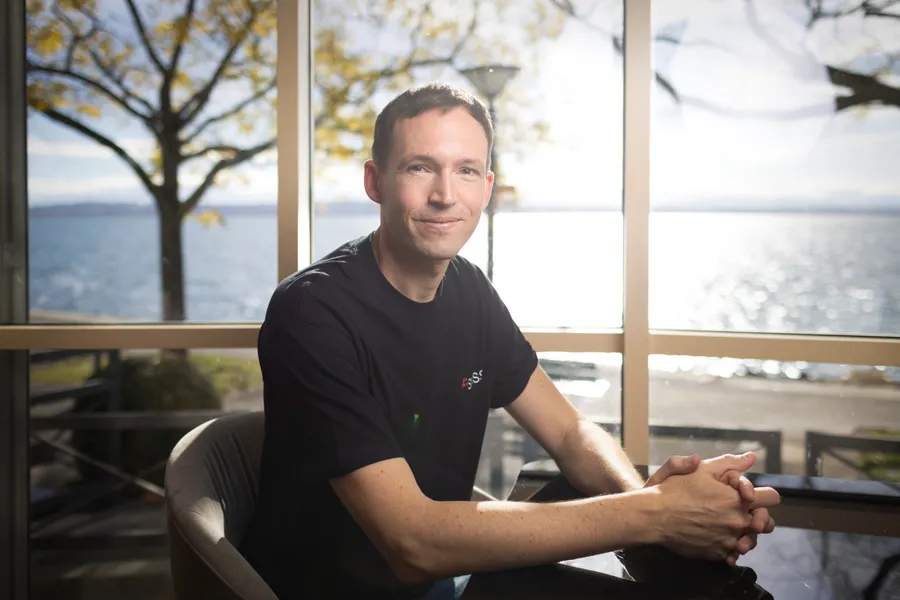
Vincent Kucholl and Vincent Veillon devote a special edition to artificial intelligence. Their guest is Charles-Edouard Bardyn, Vice-President and Chief Scientific Officer of AI Swiss.

Programmes, reports, opinion pieces and columns about AI Swiss and human-AI co-thinking, and the association’s research papers.







Television · 24 October 2026 · in French
Vincent Kucholl and Vincent Veillon devote a special edition to artificial intelligence. Their guest is Charles-Edouard Bardyn, Vice-President and Chief Scientific Officer of AI Swiss.
Television · in French
AI Swiss was founded shortly after ChatGPT arrived in late 2022, to bridge the gap between AI and the general public. Through talks and gatherings, it relies on education to help people learn to think together with AI.
Radio · in French
In this RTS series, François Jeannet (“On en parle”) meets members of AI Swiss to explore practical uses of AI: planning a family holiday, managing the fridge, training, preparing a speech, understanding a complex subject.

Video series · in French
What if artificial intelligence were here to think with you rather than replace you? That is the idea behind “Co-thinking with AI”, a mini-series by AI Swiss and Alp ICT. Over five episodes, it offers Swiss SMEs practical ways to bring generative AI into their everyday work.

Press · 26 October 2026 · in French
Anouch Seydtaghia presents BASE, the free, open tool designed by Charles-Edouard Bardyn to keep procedures and working methods when switching AI providers. The article mentions its use at Innovaud, a partner of the project, and notes that its development will need to be followed.



Press · in French
A free online guide teaches you to master artificial intelligence rather than consume it passively. A how-to with Charles-Edouard Bardyn, co-founder of AI Swiss.
Opinion · in French
For Charles-Edouard Bardyn, Vice-President of AI Swiss, the real danger of this century lies less in a revolt of the machines than in the resignation of humans.
Opinion · in French
When it comes to AI, should we invent a science of the reliability of its interactions with humans, or try to reduce its errors to a tolerable level?

Columns · in French
Recent articles by our Chief Scientific Officer, Charles-Edouard Bardyn, on AI, work and sovereignty.
Research paper · 19 September 2026 · Open access
DOI 10.1038/s41598-026-69820-9
Adolescents are the largest and fastest-growing age group adopting large language models, tools not designed for their needs. The paper proposes SCAFFOLD, an architecture that surrounds a model’s output with external verification, targeted repair and safe fallback while preserving data privacy. It keeps the effort that learning requires. A first prototype was piloted in a classroom with 12 to 16-year-old students and a social robot.